Guangdong LiYou Steel Structure Engineering Co., Ltd. +8619147784007 liyousteelstructure@outlook.com
 |


| Quantity: | |
|---|---|
Workshop
Online technical support, Onsite Installation, Onsite Training, Onsite Inspection, Free spare parts, Return and Replacement, Other
graphic design, 3D model design, total solution for projects, Cross Categories Consolidation, Others
Modern
Guangdong, China
Lifetime
engineer guidance
Liyou
LY001
CE Certification
Industrial Commercial
C.Z Shape Steel Channel
Sliding Door
Customized Color
Sandwich Panel Optional
Aluminum Alloy Sliding Window
SAP2000/AutoCAD /PKPM /3D3S/TEKLA
Hot Dip Galvanized
25-60 days
Single item
1X1X1 cm
1.000 kg
A typical metal building system is composed of the following:
Primary Structural Frame
Heavy-duty steel columns, beams, and tapered rigid frames that form the backbone of the structure and support vertical and lateral loads.
Secondary Structural Members
Purlins, girts, and braces made of cold-formed steel that help distribute loads and provide additional support for the roof and walls.
Roof and Wall Panel Systems
Metal roof and wall cladding panels designed to protect the interior from weather elements while contributing to energy efficiency.
Fasteners & Connections
Bolts, anchor systems, and specialized connectors that join all components into a single integrated system.
When combined, these components form a complete metal building system that can span large areas with minimal internal supports.
Metal building systems offer a range of benefits compared to traditional construction:
Faster Construction Time
Because components are prefabricated, on-site assembly is significantly quicker than traditional methods, reducing total project time.
High Strength and Durability
Steel building systems provide outstanding structural strength and resistance to wind, snow, and seismic loads. Steel is also resistant to pests, rot, and many environmental stressors.
Cost-Effective Over Lifecycle
Metal building systems often result in lower overall project costs due to reduced labor, minimal waste, and long-lasting materials.
Design Flexibility
Metal building systems can be customized in terms of size, layout, roof style, and finishes to meet specific architectural and functional requirements.
Sustainability and Recyclability
Steel is one of the most recycled materials globally, which helps reduce environmental impact and supports sustainable building practices.
Metal building systems are used in a broad range of building types:
Industrial Structures — Factories, warehouses, workshops
Commercial Facilities — Retail buildings, offices
Agricultural Buildings — Barns, storage sheds
Recreational Spaces — Sports facilities, community halls
Specialty Structures — Aircraft hangars, distribution centers
Their versatility and cost-efficiency make them a popular choice in both commercial and industrial real estate sectors.
Metal building systems start with engineering and design, where structural requirements such as load capacity, span width, and environmental conditions are defined. The components are then fabricated in a factory environment with precise measurements and quality control.
Once delivered to the construction site, these prefabricated parts are assembled using bolted connections, which streamline construction and allow for fast, safe erection. This method reduces construction delays, weather-related issues, and on-site labor requirements.
PRODUCT SPECIFICATIONS
| No | Components | Specification | ||
| Embedded Parts | ||||
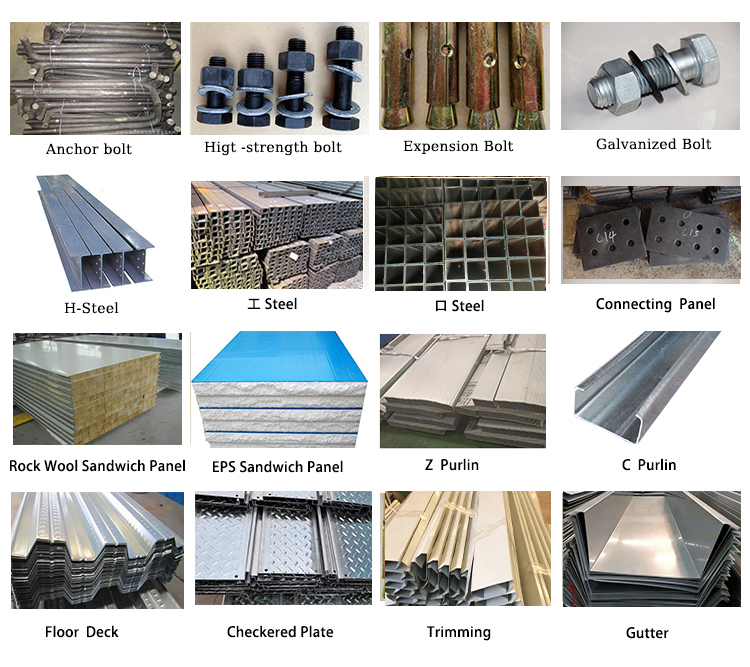
| 1 | Anchor Bolt | M24 | ||
| 2 | High Strength Bolt | M20,10.9S | ||
| 3 | Common Bolt | M16 | ||
| 4 | Galvanized Bolt | M12 | ||
| 5 | Shear Nail | M16 | ||
| 6 | Tir rod | ∅32*2.5 | ||
| Main Steel Structure Parts | ||||
| 1 | Steel Column (Q355B) | H550*300*10*16 | ||
| 2 | Wind Column (Q355B) | H400*220*6*10 | ||
| 3 | Roof Frame Beam (Q355B) | H900~500*220*10*12 H500~650*220*8*12 | ||
| 4 | Crane Beam (Q355B) | H650*320/240*10*16/14 | ||
| 5 | Tie Bar(Q235B) | ∅168*4.0 | ||
| 6 | Horizontal Brace (Q235B) | ∅168*4.0 | ||
| 7 | Column Brace (Q235B) | ∅25 | ||
| 8 | Angle Brace (Q235B) | L63*5.0 | ||
| 9 | Roof Purlin (Galvanized) | Z280*80*20*2.5 | ||
| 10 | Wall Purlin (Galvanized) | C250*75*20*2.5 | ||
| 11 | Connecting Plate | 6mm-30mm | ||
| Other Steel Structure Parts | ||||
| 1 | Roof Panel | 50mm Rock wool Sandwich panel | ||
| 2 | Wall Panel | 50mm Rock wool Sandwich panel | ||
| 3 | Gutter | 2mm Galvanized Steel Plate | ||
| 4 | Down Pipe | PVC160 (Including parts) | ||
| 5 | Trimming | Color steel 0.5mm Gavanized steel panel | ||