
Guangdong LiYou Steel Structure Engineering Co., Ltd. +8619147784007 liyousteelstructure@outlook.com
Views: 31 Author: Site Editor Publish Time: 2026-03-14 Origin: Site
In modern industrial plants, warehouses, and commercial steel buildings, the portal frame has become one of the most widely used and efficient structural systems. Its popularity comes from its clear load transfer path, high material efficiency, and ability to create large open spans at relatively low cost.
However, many steel structure projects experience issues such as excessive deflection, joint cracking, bolt loosening, or even long-term structural instability. In most cases, these problems are not caused by poor steel quality, but by improper portal frame detail design or insufficient construction control.
Structural details play a critical role in the overall performance of a portal frame system. Each connection not only transfers loads but also determines the stiffness, durability, and safety of the entire building.
Well-designed portal frame detail can:
Improve bending and shear resistance
Reduce stress concentration at joints
Extend the service life of the structure
Lower long-term maintenance and reinforcement costs
On the other hand, poorly executed details often become weak points that compromise structural integrity.
This article explains the core components, design logic, and construction best practices of portal frame detail from a practical engineering perspective, helping you understand how this system works and why it delivers real value in steel building projects.
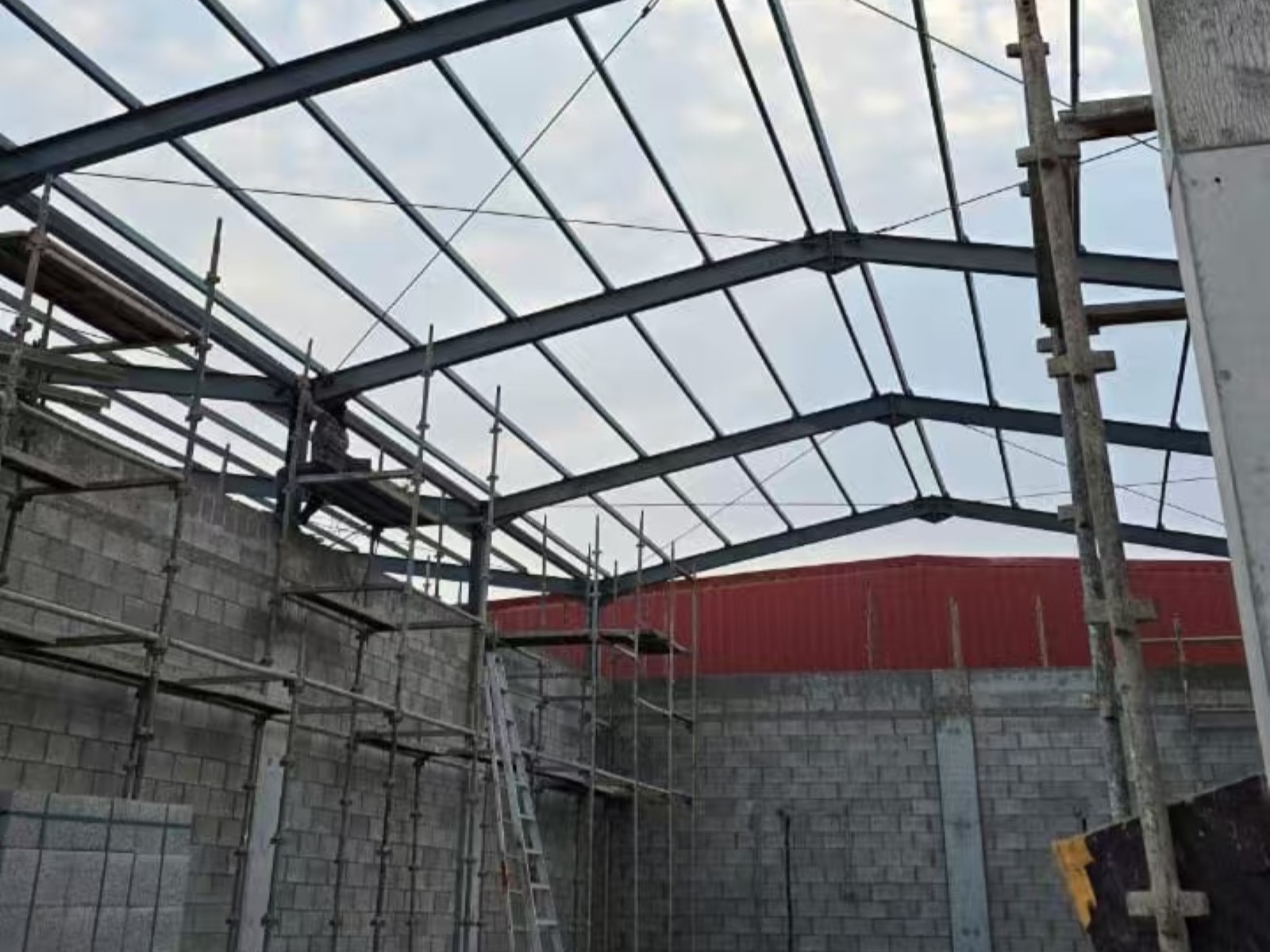
A portal frame is a rigid structural system formed by steel columns and rafters connected with moment-resisting joints. Its main characteristics include:
Rigid beam-to-column connections
Load resistance through combined bending moments and shear forces
Overall stability dependent on joint stiffness
Typical components include:
Columns that transfer loads to the foundation
Rafters that support roof loads
Knee joints that form critical rigid connections
Apex connections that ensure structural continuity
In a portal frame structure, loads are not simply transferred vertically. Roof and wind loads create bending moments in beams and columns, which are then transmitted through joints to the foundations.
If joint stiffness is insufficient:
Excessive rotation occurs at beam-column connections
Lateral deflection increases
Roof sag becomes more pronounced
With properly designed portal frame detail:
The structure behaves as a stable integrated system
Wind uplift and lateral forces are effectively resisted
Seismic performance is significantly improved
In practice, portal frame detail determines whether the building truly functions as a rigid frame system.
The column base is the starting point of load transfer and one of the most critical structural areas.
It typically consists of:
Base plate
Anchor bolts
Non-shrink grout layer
The base plate:
Distributes concentrated column loads into the concrete foundation
Resists bending moments and shear forces at the column base
If the plate is too thin, local buckling may occur, leading to uneven force distribution.
Anchor bolts resist:
Uplift forces caused by wind suction
Horizontal shear forces
Improper bolt quantity or layout may result in bolt failure or excessive joint rotation.
Grout ensures full contact between the base plate and foundation, allowing uniform load transfer. Poor grouting can create voids that lead to stress concentration.
High-quality portal frame detail at the column base prevents settlement, loosening, and fatigue damage.
The knee joint is the most critical and highly stressed part of the portal frame.
It carries:
Large bending moments
Shear forces
Axial loads
High-strength bolted connections
Welded joints
Stiffeners to increase rigidity
Haunch plates to enhance bending resistance
Haunch plates increase the effective section depth at the joint, which:
Raises moment capacity
Reduces stress concentration
This allows portal frames to achieve spans of 20–40 meters or more without excessive steel consumption.
Proper knee joint design is essential for large-span steel buildings.
The apex connection joins two rafters at the roof ridge.
Its main functions include:
Transferring bending moments
Maintaining structural continuity
If the apex connection is too flexible:
Mid-span deflection increases
Wind resistance decreases
Typical solutions include:
Splice plates with high-strength bolts
Stiffening elements for rigidity
Although secondary members, purlins and wall girts are vital to building performance.
They:
Support roof and wall panels
Transfer wind loads to the main frame
Key design considerations:
Proper spacing, usually 1.2 m to 1.8 m
Corrosion protection such as galvanizing
Secure fastening systems
Poor detailing may lead to vibration, panel deformation, or even detachment.

Design must consider:
Dead loads from steel and roofing systems
Live loads from equipment and maintenance
Wind loads including uplift and lateral pressure
Seismic forces
Connections should be designed for the most critical load combinations.
Larger spans generate higher bending moments, requiring stronger joints and larger sections.
Taller buildings experience increased wind loads, making joint stiffness even more important.
Higher-strength steel can reduce member size and weight but demands higher fabrication precision and connection quality.
| Common Issue | Structural Impact | Engineering Result | Recommended Solution |
|---|---|---|---|
| Insufficient stiffening | Stress concentration | Joint cracking and fatigue | Add stiffeners and haunch plates |
| Inadequate bolt quantity | Low capacity | Connection failure | Redesign per standards |
| Misaligned foundations | Eccentric loading | Structural deformation | Accurate setting-out |
| No thermal movement allowance | Thermal stress buildup | Cracks and distortion | Provide expansion joints |
CNC cutting for precision
Strict hole position tolerance
Weld inspection using ultrasonic testing
Erect columns and rafters in sequence
Continuously check alignment and elevation
Control bolt tightening torque accurately
These procedures ensure structural accuracy and long-term safety.
Successful portal frame detail execution depends on:
Accurate structural engineering calculations
High-precision fabrication equipment
Strict quality management systems
Liyou Steel Structure brings extensive international project experience, delivering complete solutions from design and fabrication to on-site technical support, ensuring each portal frame project is safe, durable, and cost-effective.
The real advantages of portal frame structures are only achieved when structural details are properly designed and constructed.
From column base connections to reinforced knee joints, from ridge splices to purlin systems, every portal frame detail directly affects building safety, efficiency, and service life.
Partnering with experienced steel structure professionals ensures long-term performance and reduced project risk. Contact us at liyousteelstructure@outlook.com
