
Guangdong LiYou Steel Structure Engineering Co., Ltd. +8619147784007 liyousteelstructure@outlook.com
Views: 42 Author: Site Editor Publish Time: 2026-03-30 Origin: Site
In modern industrial construction, portal frames are one of the most widely used structural systems. Whether for manufacturing plants, warehouses, logistics centers, or agricultural facilities, portal frames are valued for their structural efficiency, flexible span capacity, and ease of construction.
This article provides a systematic overview of:
What portal frames are
Their structural behavior and load transfer principles
Key structural components
Typical industrial applications
Important design and construction considerations
The goal is to help investors, engineers, and project managers clearly understand this structural system and make informed decisions.
Portal frames are rigid frame structures formed by columns and rafters connected with moment-resisting joints. These rigid connections allow the frame to transfer bending moments, shear forces, and axial forces.
Key characteristics include:
Columns and rafters act as a unified structural system
Joints are capable of resisting bending moments
Commonly used in single-story or low-rise buildings
This structural form is particularly suitable for industrial buildings.
In portal frames:
Vertical loads, such as dead and live loads from the roof, are transferred from rafters to columns
Lateral loads, including wind and seismic forces, are distributed through rigid joints within the frame
The entire frame resists bending and shear as an integrated system
Because of the rigid connections, portal frames provide strong overall stability and lateral resistance.
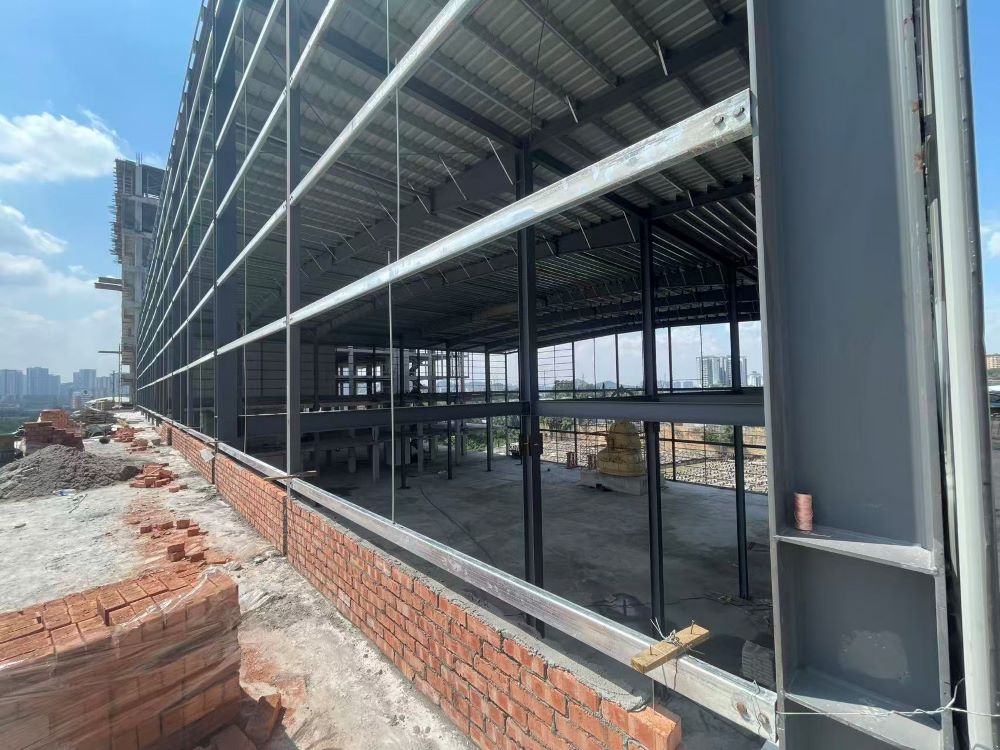
The load path in portal frames is clear and efficient:
Roof loads are carried by the rafters
Rafters transfer loads to the columns
Columns transfer loads to the foundations
Lateral forces are resisted through frame action, where bending deformation allows the structure to maintain equilibrium.
This system reduces the need for excessive additional lateral-resisting elements, improving material efficiency.
The defining feature of portal frames is the moment-resisting joint.
Compared to pinned structures:
| Comparison Item | Portal Frames | Pinned Structures |
|---|---|---|
| Joint Type | Rigid | Pinned |
| Moment Transfer | Yes | No |
| Structural Stiffness | Higher | Lower |
Rigid joints are typically achieved through:
High-strength bolted connections
Welded connections
Proper joint design is critical to overall structural performance.
To enhance stability, portal frames are usually combined with:
Roof bracing systems
Wall bracing systems
Horizontal tie members
These secondary systems ensure structural stability during both construction and service life.
Typical characteristics of portal frames include:
Single-span or multi-span layouts
Large clear-span capability
Dual-slope or pitched roof configurations
Careful design of span length and column spacing allows engineers to balance structural safety and material efficiency.
The main load-bearing components include:
Columns
Rafters
Knee joints at column-rafter connections
These members form the primary structural skeleton of portal frames.
Secondary elements support the cladding system and improve overall stability:
Purlins
Girts
Bracing members
Properly designed secondary framing contributes to load distribution and structural integrity.
Portal frames are typically connected to reinforced concrete foundations using:
Pre-embedded anchor bolts
Base plates
Grouting beneath base plates
Foundation design must be coordinated with the superstructure to ensure compatibility in load transfer.

Portal frames optimize material usage by integrating load resistance into a rigid frame system, resulting in an economical structural solution.
This system is ideal for column-free interior spaces, which benefit:
Production line layouts
Heavy equipment installation
Internal logistics flow
Structural members are prefabricated in a controlled factory environment and assembled on-site, reducing overall construction time.
With proper engineering optimization, portal frames can reduce steel consumption through efficient member sizing and layout planning.
Portal frames are well suited for large storage spaces that require unobstructed interior layouts.
They accommodate production equipment, overhead cranes, and flexible facility planning.
Commonly used for grain storage, livestock housing, and other large-span agricultural structures.
Large open spaces improve operational efficiency in distribution and material handling.

Portal frames must be engineered in accordance with applicable local codes, including requirements for:
Wind loads
Snow loads
Seismic loads
Code compliance is essential to ensure structural safety and long-term reliability.
High manufacturing accuracy directly affects installation efficiency and structural performance. Key factors include:
Dimensional precision
Welding quality
Surface treatment and corrosion protection
Standardized fabrication processes improve project consistency and durability.
A typical installation sequence includes:
Erecting steel columns
Installing rafters
Adding bracing systems
Installing purlins and cladding systems
Proper construction planning ensures structural stability and schedule control.
Compared with truss systems:
Portal frames offer a simpler structural configuration
They are well suited for medium-span industrial buildings
Compared with conventional rigid frames:
Portal frames are more commonly used in single-story industrial buildings
They provide standardized and efficient construction solutions
Different structural systems should be selected based on functional and economic requirements.

As one of the most mature and widely adopted structural systems in industrial construction, portal frames achieve an effective balance between structural performance, economy, and constructability.
With proper engineering design and controlled fabrication, portal frames provide a reliable and efficient solution for industrial buildings worldwide. Understanding their structural principles and components enables owners and project teams to make sound, technically informed decisions that support long-term operational success.
For expert guidance and a customized solution for your portal frames project, contact us today at liyousteelstructure@outlook.com — our engineering team is ready to assist you.
