
Guangdong LiYou Steel Structure Engineering Co., Ltd. +8619147784007 liyousteelstructure@outlook.com
Views: 36 Author: Site Editor Publish Time: 2026-04-02 Origin: Site
As global industrialization and infrastructure development continue to accelerate, steel building design has become one of the most widely adopted solutions for industrial plants, warehouses, logistics centers, commercial buildings, and public facilities.
Compared with traditional concrete structures, steel buildings offer clear advantages in construction speed, structural strength, seismic performance, and sustainability.
This guide explains the full process of steel building design, including key technical parameters, cost structure, and common mistakes. It is intended to help developers, project owners, and procurement managers make informed and professional decisions.
Steel building design refers to the complete engineering process of designing a structural system based on steel components, including structural planning, load calculations, connection detailing, and fabrication drawings.
The core elements typically include:
Structural system selection (Portal Frame / Steel Frame / Truss System)
Load calculations (Dead Load / Live Load / Wind Load / Seismic Load)
Member section design (H-beam / C-section / Box Column)
Connection detailing (Bolted Connection / Welded Connection)
Corrosion protection and fire resistance design
| Structural Type | Typical Applications | Key Features |
|---|---|---|
| Portal Frame | Single-story industrial buildings | Cost-effective, suitable for large spans |
| Steel Frame Structure | Multi-story commercial buildings | High structural stability |
| Truss Structure | Stadiums, aircraft hangars | Ideal for long-span spaces |
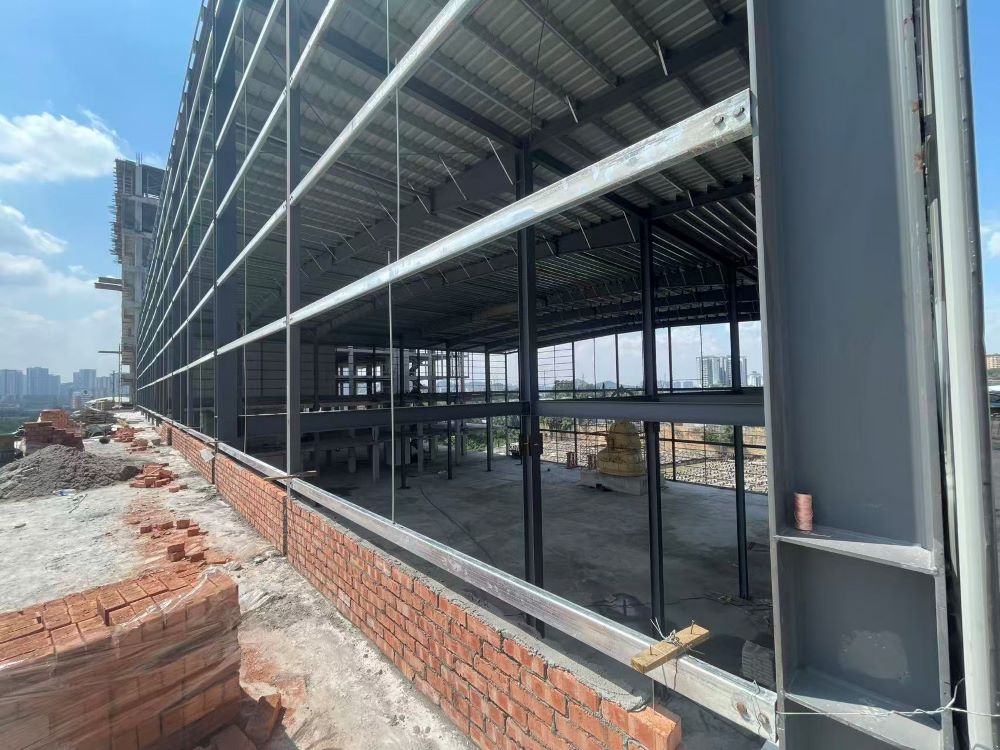
A professional steel building design project usually includes the following six stages:
Confirm building function (warehouse / workshop / office)
Determine span and height requirements
Define crane loads if applicable
Evaluate local climate conditions such as wind and snow loads
Confirm seismic design requirements
Design standards vary by country. For example:
The United States typically follows IBC and AISC standards
Europe follows Eurocode 3
China follows GB 50017
The design must strictly comply with local building codes.
Professional software is used for structural analysis, such as:
Tekla Structures
SAP2000
ETABS
Through 3D modeling, engineers perform:
Load analysis
Member stress calculations
Deflection control
Stability analysis
The structure must meet requirements for:
Strength
Stiffness
Stability
Fatigue resistance when dynamic loads are present
Common material grades include:
Q235
Q355
ASTM A36
ASTM A572
The objectives of structural optimization are:
Reduce steel consumption
Control overall project cost
Improve structural efficiency
Effective steel optimization can typically reduce steel usage by 5% to 15%, depending on project conditions.
Connection methods directly affect structural safety and construction efficiency.
| Connection Type | Advantages | Typical Use |
|---|---|---|
| Bolted Connection | Easy installation | On-site assembly |
| Welded Connection | High strength | Factory prefabrication |
The mainstream approach today combines factory welding with high-strength bolted connections on site.
Steel structures require proper protection measures.
Hot-dip Galvanizing
Epoxy Painting
Polyurethane Coating
1-hour rating
2-hour rating
3-hour rating
The thickness of fireproof coatings must be determined according to the required fire resistance rating specified in the design.
Detailed engineering includes:
Member breakdown
Bolt numbering
Bill of Materials (BOM)
Installation drawings
Accurate detailing reduces construction errors and minimizes on-site rework.

Several technical parameters significantly impact both cost and safety.
Common range: 12 meters to 36 meters
Spans exceeding 36 meters typically require specialized structural solutions
Common range: 6 meters to 9 meters
Directly influences steel consumption
Typical industrial buildings: 6 meters to 12 meters
| Building Type | Average Steel Usage |
|---|---|
| Standard warehouse | 25 to 35 kg per square meter |
| Heavy industrial workshop | 35 to 60 kg per square meter |
Actual quantities must always be determined through structural calculations.
The total steel building design cost generally includes:
Structural steel materials, typically 50 to 70 percent of total cost
Design and detailing services
Fabrication costs
Surface treatment costs
Transportation and erection
Key factors influencing cost:
Span
Crane loads
Wind and snow loads
Fire resistance requirements
Fluctuations in steel market prices
For large-span buildings, steel building design is often more economical than reinforced concrete.
Wind and snow loads vary by region. Each project requires independent structural calculations.
Structural optimization has a greater impact on total project cost than material unit price alone.

With the advancement of BIM technology, steel building design is becoming increasingly digitalized.
Key developments include:
3D visualization modeling
Clash detection
Construction simulation
Remote collaborative design
These technologies significantly reduce design errors and improve construction efficiency.
A reliable steel structure partner should offer:
Strong knowledge of international design standards
Extensive overseas project experience
Integrated design, fabrication, and installation capabilities
A mature quality management system
In real-world projects, professional steel building design not only ensures structural safety but also directly impacts return on investment.
For professional support and customized steel building design solutions, please contact our engineering team at liyousteelstructure@outlook.com.
