Guangdong LiYou Steel Structure Engineering Co., Ltd. +8619147784007 liyousteelstructure@outlook.com
 |


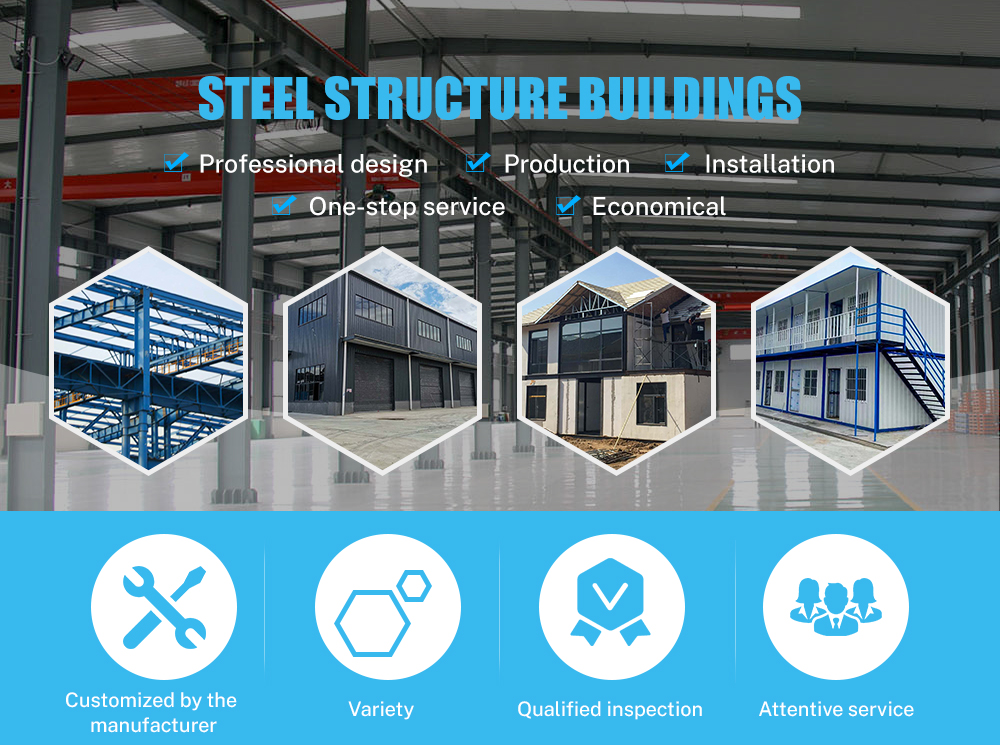
Liyou's iron buildings are designed to meet the evolving demands of modern infrastructure — combining structural durability with customizable engineering. Whether you're developing industrial hubs or expanding commercial facilities, our iron structures offer long-lasting performance with global export capabilities.
Main Frame: Welded H-beam or I-beam iron/steel sections.
Cladding: Corrugated steel panels or insulated sandwich panels.
Roof Pitch: 10–30° customizable.
Connection Type: Bolt and weld combination.
Finish: Galvanized or powder-coated options.
Span Capability: Up to 60 meters without interior support.
(For project-specific specs, we recommend contacting our technical team.)
| Quantity: | |
|---|---|
Workshop
Online technical support, Onsite Installation, Onsite Training, Onsite Inspection, Free spare parts, Return and Replacement, Other
graphic design, 3D model design, total solution for projects, Cross Categories Consolidation, Others
Modern
Guangdong, China
Lifetime
engineer guidance
Liyou
LY001
CE Certification
Industrial Commercial
C.Z Shape Steel Channel
Sliding Door
Customized Color
Sandwich Panel Optional
Aluminum Alloy Sliding Window
SAP2000/AutoCAD /PKPM /3D3S/TEKLA
Hot Dip Galvanized
25-60 days
Single item
1X1X1 cm
1.000 kg
Iron buildings refer to metal structures using iron‑based materials (commonly modern structural steel) for the load‑bearing framework of a building. In current construction practice, iron is predominantly used in the form of steel beams, columns, and trusses as the structural backbone of industrial, commercial, and storage facilities.
Although the term iron buildings historically referred to structures built with cast or wrought iron, in modern usage it generally describes buildings that have a steel‑based structural frame. Structural steel components such as I‑beams and H‑beams — often coated for corrosion resistance — form the skeleton of these buildings, providing high strength and stability.
Iron buildings typically involve:
Steel columns and beams that support the load
Rigid structural systems that create clear‑span interiors
Metal roof and wall cladding systems
Compatibility with custom design and expansion
In modern metal building practice, the iron used in "iron buildings" is usually part of steel structural systems. Steel for construction is manufactured from iron with additional alloying to improve strength and ductility.
Steel buildings offer high compressive and tensile strength and resist deformation under load, making them suitable for both heavy‑duty and large‑span applications.
Iron buildings are widely used where durable and flexible metal structures are required:
Warehouses and logistics centers — clear interior space for storage
Industrial and fabrication facilities — heavy loads and machinery support
Aircraft hangars — large open spans without interior columns
Agricultural storage — barns and equipment sheds
Commercial and retail facilities — adaptable interior layouts
Workshops and service centers — robust frames and utility integration
These applications benefit from steel's strength, design flexibility, and long service life.
Iron buildings (steel buildings) offer several practical advantages over traditional construction materials:
High Structural Strength
Steel's excellent strength‑to‑weight ratio allows for larger spans and open interiors without interior supports.
Durability and Longevity
Steel structures resist warping, cracking, and pests, providing long‑lasting performance.
Design Flexibility
Steel framing systems can be engineered for specific height, load, and layout requirements.
Faster Construction
Prefabricated steel components speed up manufacturing and on‑site assembly.
These benefits make iron/steel buildings a preferred choice for industrial and commercial construction.
| Feature | Iron (Steel) Buildings | Traditional Materials |
|---|---|---|
| Structural Strength | High | Moderate |
| Clear Span Capability | Excellent | Limited |
| Construction Time | Short | Relatively Long |
| Flexibility in Layout | High | Moderate |
| Maintenance | Low | Higher |
Compared to concrete or wood structures, iron/steel buildings often deliver greater open space and adaptability.
PRODUCT SPECIFICATIONS
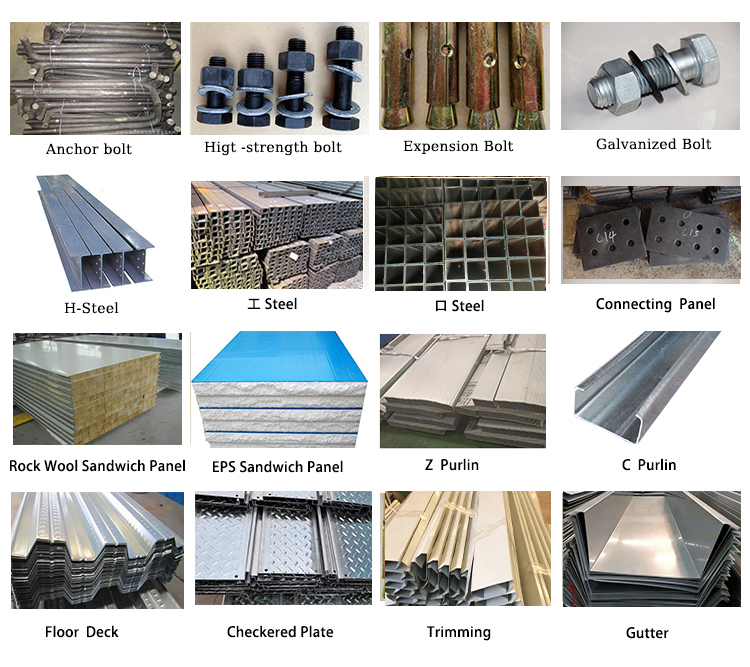
| No | Components | Specification | ||
| Embedded Parts | ||||
| 1 | Anchor Bolt | M24 | ||
| 2 | High Strength Bolt | M20,10.9S | ||
| 3 | Common Bolt | M16 | ||
| 4 | Galvanized Bolt | M12 | ||
| 5 | Shear Nail | M16 | ||
| 6 | Tir rod | ∅32*2.5 | ||
| Main Steel Structure Parts | ||||
| 1 | Steel Column (Q355B) | H550*300*10*16 | ||
| 2 | Wind Column (Q355B) | H400*220*6*10 | ||
| 3 | Roof Frame Beam (Q355B) | H900~500*220*10*12 H500~650*220*8*12 | ||
| 4 | Crane Beam (Q355B) | H650*320/240*10*16/14 | ||
| 5 | Tie Bar(Q235B) | ∅168*4.0 | ||
| 6 | Horizontal Brace (Q235B) | ∅168*4.0 | ||
| 7 | Column Brace (Q235B) | ∅25 | ||
| 8 | Angle Brace (Q235B) | L63*5.0 | ||
| 9 | Roof Purlin (Galvanized) | Z280*80*20*2.5 | ||
| 10 | Wall Purlin (Galvanized) | C250*75*20*2.5 | ||
| 11 | Connecting Plate | 6mm-30mm | ||
| Other Steel Structure Parts | ||||
| 1 | Roof Panel | 50mm Rock wool Sandwich panel | ||
| 2 | Wall Panel | 50mm Rock wool Sandwich panel | ||
| 3 | Gutter | 2mm Galvanized Steel Plate | ||
| 4 | Down Pipe | PVC160 (Including parts) | ||
| 5 | Trimming | Color steel 0.5mm Gavanized steel panel | ||